1. Analogy
Generally speaking, a base is a reference system in which things are expressed. For example, the number $64$ is written 1000 in the base $2$ (binary base). They are in fact the same number but they are expressed (represented) in different bases :
The natural base for numbers is the base 10. As regards vectors, the natural base is called the standard basis (also called canonical basis).
2. Representations
As for numbers, vectors are represented with respect to a basis.
Example I
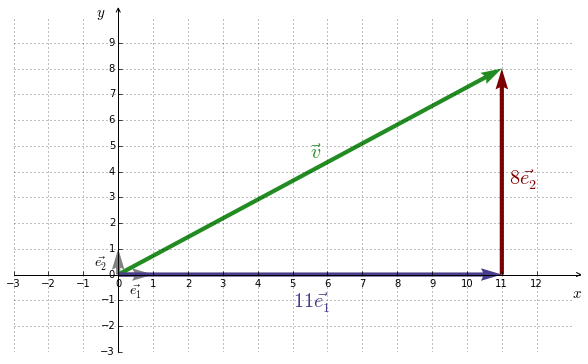
Figure 8.1 shows the vector $\vec{v}= \left( \begin{smallmatrix} 11 \\ 8 \end{smallmatrix} \right)$ represented in the standard basis of $\mathbb{R}^2$, namely $STD = \{ \underbrace{\left( \begin{smallmatrix} 1 \\ 0 \end{smallmatrix} \right)}_\vec{e_1},
\underbrace{\left( \begin{smallmatrix} 0 \\ 1 \end{smallmatrix} \right)}_\vec{e_2} \}$.
In fact, $\vec{v}$ is the result of a linear combination of the basis vectors :
Let $B= \{ \underbrace{ \left( \begin{smallmatrix} 4 \\ 1 \end{smallmatrix} \right)}_{\vec{k_1}},
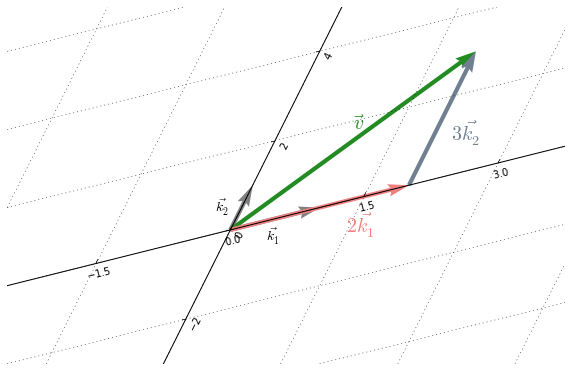
\underbrace{ \left( \begin{smallmatrix} 1 \\ 2 \end{smallmatrix} \right) }_{\vec{k_2}} \}$ be a basis of $\mathbb{R}^2$. Let’s represent $\vec{v}$ in $B$.
To do that, we need to solve the following equation :
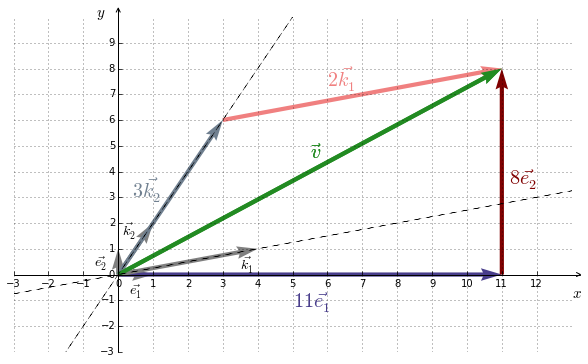
In $(3)$ the coefficients $\lambda_i$ are the so-called components. By solving $(3)$ we get $2$ and $3$ as components of $\vec{v}$ with respect to $B$.
Figure 8.2 shows $\vec{v}$ in $B$.
We have thus the vector $\vec{v}$ represented in two different bases :
3. Conditions
For a set of vectors to form a basis, the following conditions must be met :
- Any vector of a given space must be constructed from a linear combination of the basis vectors. That is the goal of a basis.
- The vectors of the basis must be linearly independent.
4. Change of basis
To convert a vector from a given basis $B$ into the standard basis, the following formula can be used :
Example II
Let’s convert $\vec{v}=\left( \begin{smallmatrix} 2 \\ 3 \end{smallmatrix} \right)$ from the basis $B=\{\left( \begin{smallmatrix} 4 \\ 1 \end{smallmatrix} \right),\left( \begin{smallmatrix} 1 \\ 2 \end{smallmatrix} \right)\}$, into the standard basis.
Wrap-up
Any vector is expressed with respect to a given basis. By default, vectors are expressed in the standard basis.
The standard basis of the space $\mathbb{R}^{2}$ is $\{ \left( \begin{smallmatrix} 1 \\ 0 \end{smallmatrix} \right),
\left( \begin{smallmatrix} 0 \\ 1 \end{smallmatrix} \right)
\}$. The standard basis of the space $\mathbb{R}^{3}$ is $\{ \left( \begin{smallmatrix} 1 \\ 0 \\ 0 \end{smallmatrix} \right),
\left( \begin{smallmatrix} 0 \\ 1 \\ 0 \end{smallmatrix} \right),
\left( \begin{smallmatrix} 0 \\ 0 \\ 1 \end{smallmatrix} \right)
\}$.
A basis of a given space generates, by linear combination, any vector of that space.
The components of a vector are the coefficients of the linear combination of the basis vectors.
Each base of $\mathbb{R}^{2}$ contains $2$ vectors, each base of $\mathbb{R}^{3}$ contains $3$ vectors, etc. Generally speaking, each base of $\mathbb{R}^{n}$ contains $n$ vectors.